
Crypto & Its Real World Utility
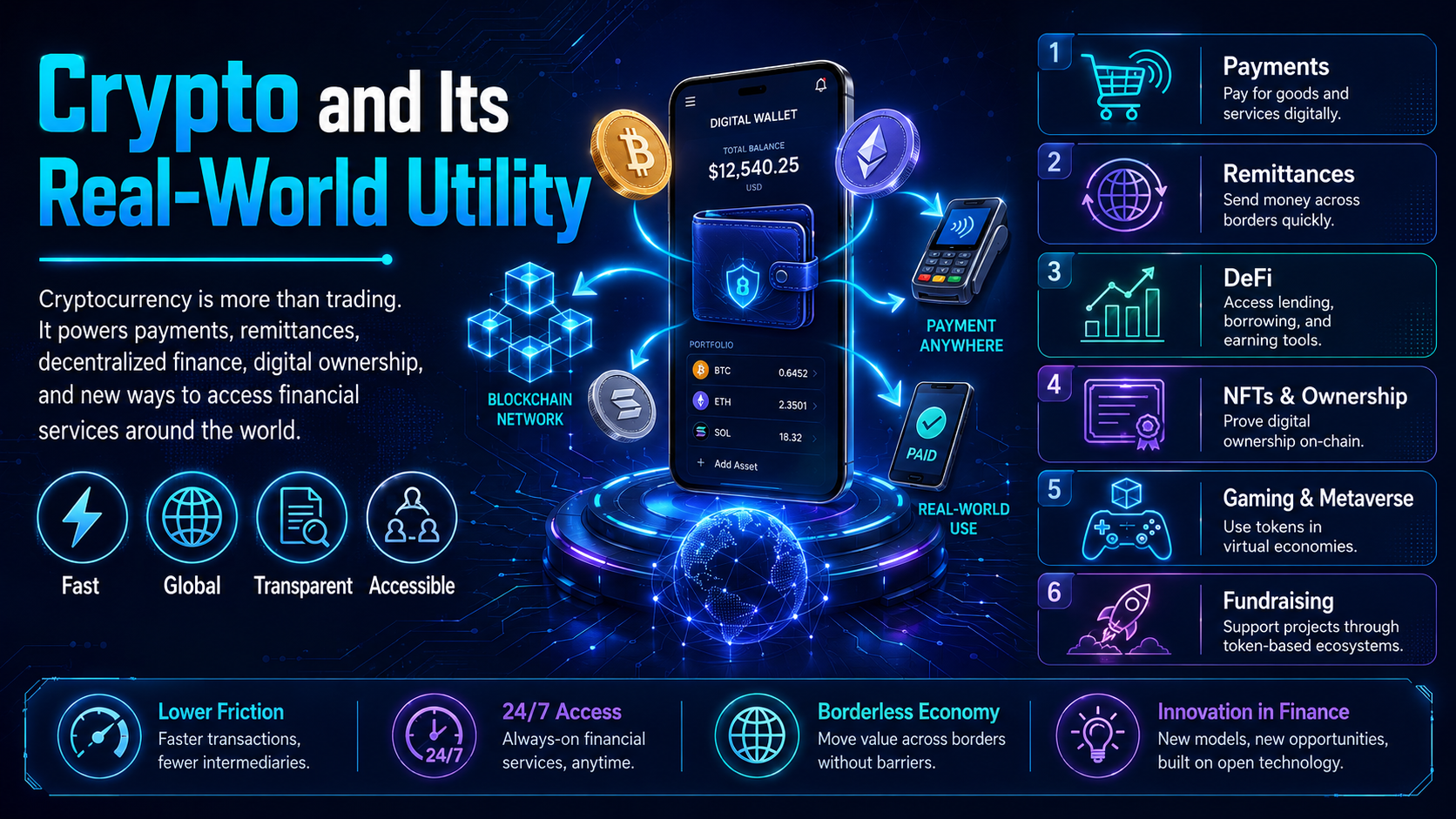
Cryptocurrency started as digital money. Now it has become the backbone of real-world innovation. This virtual currency is utilized primarily for trading or investing. But there is much more one can expect.
These days, crypto is being used in real-world scenarios, like transferring funds across borders and helping businesses run more efficiently with automated contracts.
In fact, people use crypto in their daily lives for multiple purposes, such as shopping, saving, and even tracking goods in supply chains. In this blog, we will explore how crypto is moving beyond the screen and making a real impact in the world around us.
What Is Cryptocurrency & Why It Matters Today
Cryptocurrency is a type of virtual money that lives online. You can’t touch it or put it in your wallet, but you can use it to buy things, send money, or invest — just like regular currency.
What makes crypto different? It is not maintained or controlled by the government or any other financial institution. Instead, it functions using a special technology called blockchain. It is akin to a public record book that people can view, but no one can secretly modify its transactions.
Imagine being able to transfer money to someone in another country in minutes, without incurring huge fees or delays. Or creating a contract that works on its own — no middleman needed. That’s what crypto makes possible.
It matters today because it offers:
- More control over your money
- Faster and cheaper payments
- Access to financial tools for people without banks
- New ways to safeguard your identity, your assets, and your future
As the world becomes more digital, cryptocurrency is becoming more than just a trend — it is a tool for real change.
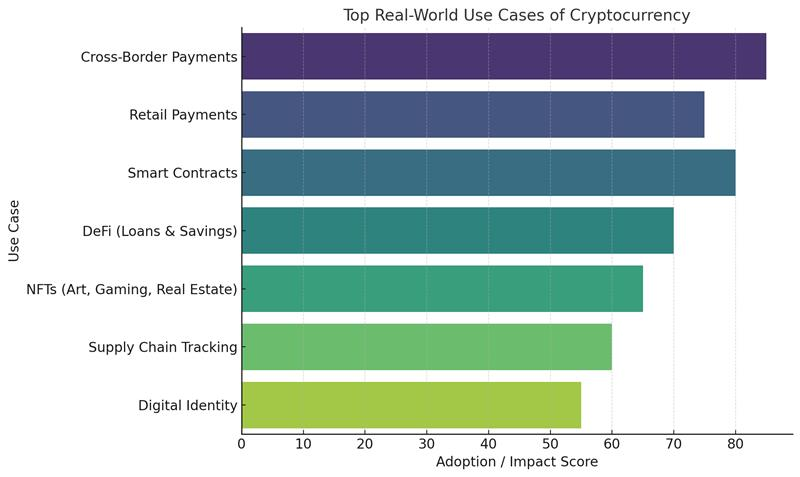
Real-World Use Cases of Cryptocurrency
- Global Payments And Remittances
Earlier, it was extremely difficult to transfer money to someone living in another country. The process was often slow and involved banks and other intermediaries. Traditional methods can take several days and charge high fees — especially for people sending small amounts to family or friends in other countries.
Cryptocurrency solves this problem. It helps individuals send money directly, quickly, and at minimal fees — no long wait times.
Example:
Krishna wants to send ₹10,000 to his brother in another country.
It may take 2–5 days and incur fees of ₹500 (or more) when he transacts with a bank.
But with Crypto, the money can be transferred in minutes at a minimal percentage. His brother can then convert it into local currency or spend it directly if crypto is accepted.
Popular Cryptos Used:
Bitcoin and Ethereum — These coins are widely utilized for different purposes, but sometimes have high fees.
Stellar and Ripple — These cryptos are created for speedy, low-cost global payments.
Stablecoins — These are great for sending exact amounts without any price modifications.
- Retail & E-Commerce Payments
Cryptocurrency is now used to purchase products and services online or in-store. Many businesses today accept cryptocurrency as a method of payment, ranging from coffee shops to major online retailers.
Consumers can pay directly using digital coins. These payments are extremely quick, safe, and do not need any middleman.
Example 1: Buying Coffee
Emma walks into a local café that accepts Bitcoin. She scans a QR code with her crypto wallet app, approves the payment, and the café receives the money within seconds — no swiping cards or waiting for approval.
Example 2: Online Shopping
John shops on an e-commerce website that accepts USDT (a stablecoin). At checkout, he selects “Pay with Crypto,” and within minutes, the store gets paid — no long processing time or high transaction fees.
Renowned Platforms Accepting Crypto:
- Overstock – an online retailer accepting Bitcoin
- Newegg – electronics store taking crypto payments
- Shopify stores – many merchants allow crypto via payment plugins
- Some Starbucks and restaurants also accept crypto through third-party apps
- Smart Contracts for Legal & Business Agreements
A smart contract is akin to a digital agreement that executes on the blockchain. It works automatically — when the prerequisites are satisfied. It completes the action without needing a lawyer, notary, or middleman.
Smart contracts are written in code and are impossible to modify or tamper with. This makes them secure and trustworthy for handling business deals or other legal agreements.
Example 1: Freelance Work
Anna is a designer hired by a client online. They use a smart contract that says:
If Anna sends the final design files,
Then the contract will automatically release the payment to her.
No chasing payments, no third parties involved.
Example 2: Rent a Furnished Apartment
Tom chooses to rent a furnished apartment for a month. A smart contract is created with rules:
If Tom pays the rent in crypto,
Then the digital key to the apartment is sent to him.
All steps are done securely and instantly.
Why It’s Useful:
- No need for manual processing or middlemen
- Reduces delays and errors
- Everything is recorded on the blockchain for proof
- Can be used for jobs, sales, insurance, property, and more
- Decentralized Finance for Loans, Savings, & More
Decentralized Finance helps utilize financial services, such as borrowing, lending, or saving, without relying on banks or intermediaries. It operates on a blockchain using smart contracts, which ensures everything happens automatically and securely.
This DiFi system enables crypto holders to obtain a loan or earn interest, without requiring any paperwork or credit checks.
Example 1: Taking a Crypto Loan
Mihika has some Ethereum but does not want to sell/ transfer it.
She uses a Decentralized Finance app, like Aave or Compound, to lock her coins as collateral and borrows USDT (a stablecoin).
She receives instant funds and can repay later to recover her digital money.
Example 2: Earning Interest on Crypto Savings
Priya has a USDC valued at $10,000.
She deposits it into a DeFi platform like Yearn Finance, which lends it to others.
In return, Priya earns interest on her crypto, just like a savings account, but often with huge returns.
Benefits of DeFi:
- No banks or credit history required
- Open to anyone, anywhere
- Interest rates and terms are transparent
- Everything runs 24/7 on smart contracts
- NFTs and Gaming, Art, and Real Estate
Non-Fungible Tokens are digital certificates that confirm ownership of a particular item. These items may include any pieces of art, game objects, or even virtual land. They are stored on the blockchain network and are impossible to copy or fake.
NFTs are powered by cryptocurrency and smart contracts. They provide creators, gamers, and property buyers with a new way to transfer and prove ownership of their digital and physical assets.
Example 1: NFTs in Art
Suppose an artist makes a digital painting. Later, he turns it into an NFT.
When a person purchases the NFT, they own the original digital artwork (similar to owning a physical painting).
Many renowned platforms are available, like OpenSea, that help artists to sell NFTs globally.
Example 2: Gaming World and NFTs
Some blockchain games allow players to purchase NFTs, such as weapons, characters, or land.
These items then belong to the player and can be traded, sold, or used in other games.
Example 3: NFTs in Real Estate
A company creates an NFT linked to the legal documents of a property.
Buying the NFT means buying the ownership rights to that property.
This can speed up property deals, remove paperwork, and allow fractional ownership (owning part of a house).
Why NFTs Are Useful:
- Prove true digital ownership
- Let creators earn money directly
- Allow safe trading of assets
- Open new possibilities in virtual and real-world markets
- Identity Verification & Digital IDs
One needs to share personal documents like passports or ID cards to prove their identity on different websites and apps. This can be slow, repetitive, and risky if your data is leaked.
With blockchain and crypto technology, you can acquire Digital IDs — secure, private, and easy-to-use identities held in the blockchain. You control your data and share only the information that’s needed.
Example 1: One-Time Verification
Sarah wants to sign up for multiple services — a bank, a healthcare portal, and a job platform.
Instead of uploading her ID repeatedly, she uses her blockchain-based digital ID, which verifies her identity once and then allows her to reuse it securely anywhere.
Example 2: Controlling Personal Data
Jai wants to confirm he is over 18 to access a particular website.
He can show his self-sovereign digital ID, which reveals only his age and not his other information to protect his privacy.
How Blockchain Helps:
- Your identity is encrypted and stored securely
- Only you control who can see your information
- No central authority is needed — it’s decentralized and trusted
Who is Utilizing It:
- Governments for issuing blockchain-based national IDs
- Banks and Fintech for secure and fast onboarding
- Educational Institutions for diplomas and certificates
- Healthcare for managing medical records
So, we can say cryptocurrency has become a powerful tool with real-world impact. It truly transforms how we pay, trade, and interact in our everyday lives.
**************************************
Frequently Asked Questions
How is crypto used in the real world?
There are many use cases of crypto, which include global payments, retail payments, NFTs, and more.
What is the main use of crypto?
Cryptocurrency is primarily used for online transactions. One can utilize it to purchase physical assets.
What crypto is actually useful?
Among all the options, Bitcoin is the most useful crypto, widely used for a variety of purposes.
Does crypto have tax?
You pay taxes on cryptocurrency at the time of selling or using it in a transaction, and it is value more than it was when you purchased it. However, the tax regime varies based on the region of crypto trading.


Latest News