
Types of Cryptocurrencies
Bitcoin was the first cryptocurrency, but it’s no longer the only one in the crypto world. Currently, you can find multiple digital currencies present on the market; understanding alternative options and identifying which ones are performing well is crucial.
The world of cryptocurrencies is growing very quickly. Every day, multiple new currencies are created and launched. Let’s examine these currencies in detail, along with their unique purposes and applications. But before, let’s understand what cryptocurrency is.
What is Cryptocurrency?
Cryptocurrency is a type of digital money. It only exists online — there are no coins or notes you can hold. People use it to buy things, invest, or send money over the internet.
Unlike dollars, euros, or rupees, it is not managed by any regulatory bodies. Instead, it operates using a special technology called blockchain, which keeps everything secure and transparent.
Good Things About Crypto:
- It’s digital money.
- You store it in a crypto wallet (like a digital bank account).
- You can buy, sell, and trade it online.
- It gives you full control of your money.
The first-ever cryptocurrency, Bitcoin, was first used in 2009. Since then, myriads of new coins have been introduced, each with new features and purposes. This guide presents major types of cryptocurrencies – what they are and their use cases.
Types of Cryptocurrency
There are basically two types of cryptos: Bitcoins and Altcoins. Let’s discuss them in detail.
- Bitcoin
Bitcoin — the market leader in cryptocurrency that was created in 2008 by an anonymous individual, or group of individuals, using the name Satoshi Nakamoto.
This digital currency can be securely traded by people all around the world, over the Internet — they can send bitcoins to each other without the need of any Government or middleman.
The characteristic that differentiates Bitcoin is its limited supply. There will be a maximum supply of 21 million coins.
A public blockchain tracks all Bitcoin transactions. Everyone in the network can view the transactions — making it both transparent and secure.
Use cases of Bitcoins
Investment Asset: Many individuals purchase Bitcoins to profit from price fluctuations over time.
Store for the Future: Bitcoin is considered ‘digital gold’. People view it as a way to preserve wealth.
Medium of Exchange: Some store owners accept Bitcoin as a payment option to purchase goods or services.
- Altcoins
Altcoin means “alternative coin.”
Any cryptocurrency other than Bitcoin is referred to as ‘Altcoins’.
Since Bitcoin was the first crypto, all the other digital coins that came after it are called Altcoins — or alternative versions of Bitcoin.
Why Were Altcoins Created?
- To improve on Bitcoin’s limitations (like speed or energy use)
- To serve new purposes (like building apps, sending money, or creating NFTs)
- To offer more choices for users and developers
Why People Use Altcoins:
- Some are faster than Bitcoin
- Some have special uses (like games, apps, and smart contracts)
- Some are cheaper to buy and trade
- Some offer new innovations and tech features
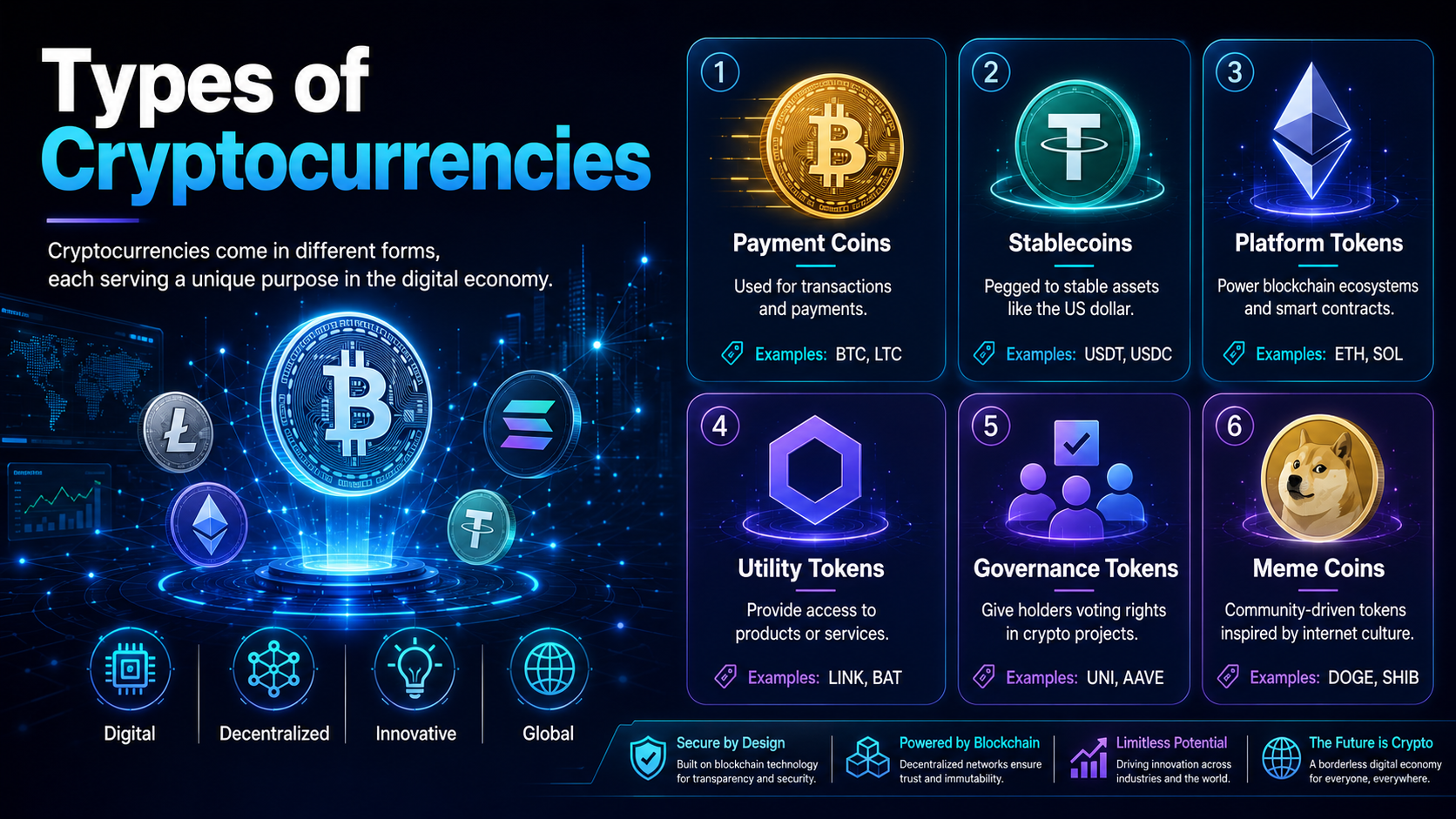
This virtual currency is divided into different categories: Payment Tokens, Stablecoins, Security Tokens, Meme Coins, and Utility Tokens.
Payment Token
A Payment Token is a type of cryptocurrency made for spending — just like digital cash.
You can use it to:
- Buy goods or services
- Send money to someone
- Make fast payments online or across countries
It’s designed to work like real money, but in digital form — no banks or middlemen needed.
Imagine you are purchasing a gadget online.
You can pay with your debit/credit card (goes through a bank).
Or, you can pay directly using a payment token like Bitcoin or Litecoin — instantly and with low fees.
Key Features of Payment Tokens
- Used for Spending: You can use them to pay for things or send money
- Fast Transactions: Payments can be done in seconds or minutes
- Low Fees: More affordable than banks or credit cards
- Borderless: Send funds anywhere in the world without limits
- Secure & Private: Based on blockchain, making transactions safe
Popular Payment Tokens:
| Token | What It Does |
| Litecoin (LTC) | Faster and cheaper version of Bitcoin for spending |
| Bitcoin Cash (BCH) | Built for everyday payments at lower fees |
| Dash (DASH) | Offers fast and private payments |
Stablecoins
A Stablecoin is one whose value stays stable — it does not fluctuate like Bitcoin or other currencies.
It involves pegging value to real-world currency, such as the US Dollar or the Indian Rupee.
So if you have 1 Stablecoin that is tied to the US Dollar, it will always be worth $1.
For Example:
Let’s say you want to keep your money in crypto but don’t want big price swings.
Instead of holding Bitcoin (which can go up or down fast), you keep it in a stablecoin like USDT or USDC — and its value stays close to $1.
Key Features of Stablecoins
- Stable Value: Price stays steady
- Easy to Use: Good for sending money, saving, or trading
- Global Access: Use it anywhere — no bank account needed
- Trusted Backing: Usually backed by real money or assets
- Low Volatility: No big ups and downs like other cryptos
Some Popular Stablecoins:
| Stablecoins | Pegged To | Use Cases |
| USDT (Tether) | US Dollar | Most used for trading and transfers |
| USDC | US Dollar | Known for transparency and stability |
| DAI | US Dollar | Decentralized stablecoin |
| BUSD | US Dollar | Created by Binance for easy payments |
Security Tokens
A Security Token is a digital version of real-world investments — like stocks, bonds, real estate, or company shares — but stored and traded on a blockchain.
It gives the holder legal rights or ownership — just like traditional investments.
For Example:
Let’s say you invest in a hotel building.
Normally, you get a paper contract or share certificate.
With security tokens, you get a digital token that proves your ownership — and you can trade it easily online.
It’s like turning your investment into a piece of code on the blockchain.
Key Features of Security Tokens
- Backed by Assets: Represents real value (like shares, property, or revenue)
- Legal Rights: Gives you ownership, voting rights, or profit share
- Secure & Transparent: Built on blockchain — safe and easy to track
- Easy to Trade: Can be bought or sold online, like stock trading
- Regulated: Often needs to follow government or financial rules
Common Uses of Security Tokens:
| Asset Type | What the Token Represents |
| Company Shares | You own a part of a company |
| Real Estate | You own a portion of a property or building |
| Bonds | You lend money to a company/government |
| Funds | You invest in a pooled asset (like mutual funds) |
Meme Coins
Meme Coins are joke-based cryptocurrencies that often start as internet memes or viral trends, but they are still real digital money.
These are usually created for fun, but some become very famous and gain value due to online communities, celebrity endorsements, and social media hype.
Example: Imagine someone makes a coin just for fun, inspired by a funny dog meme — that’s how Dogecoin started!
Key Features of Meme Coins
- Meme-Based Fun: Started as jokes or internet memes
- Community-Driven: Grow in value because fans promote them online
- Not Very Technical: Often don’t have real use or special blockchain features
- Volatile Prices: Prices can rise or fall quickly, based on hype
- Influenced by Trends: Social media, celebrities, and news can affect their value
Meme coins can be fun, but they’re risky investments — always do research before buying!
Popular Meme Coins:
| Meme Coin | What It’s Known For |
| Dogecoin (DOGE) | The first meme coin, based on a Shiba Inu dog meme |
| Shiba Inu | Another dog-themed coin, built on Ethereum |
| Pepe (PEPE) | Inspired by the Pepe the Frog meme |
| Floki Inu | Named after Elon Musk’s dog |
Utility Tokens
A Utility Token gives you access to a product, service, or feature within the blockchain.
Think of it like a digital ticket or membership card — you use it inside a system, not as general money.
For Example, let’s say there’s a crypto platform for cloud storage.
One can only utilize their service if they have their utility tokens.
The token functions like a key that allows access to features or lets you pay for services on that platform.
Key Features of Utility Tokens:
- Access Tool: Used to access features or services in the blockchain
- Inside Use Only: Works within a specific platform, not for daily shopping
- Can Be Traded: You can buy or sell them on crypto exchanges
- Sometimes Discounted: Some tokens give discounts or other perks when utilized
- Power the Platform: Often needed to run, build, or use dApps or services
Some Common Utility Tokens:
| Token | What It’s Used For |
| Ethereum | Utilized to operate apps and smart contracts on the Ethereum network |
| Binance Coin | Pay trading fees and access features on the Binance exchange |
| BAT (Basic Attention Token) | Rewarded to users for viewing advertisements on the Brave browser |
| MATIC (Polygon) | Pay for fast transactions on the Polygon network |
***************************************
Frequently Asked Questions
Q.1 What are the common cryptocurrency types?
Common cryptocurrencies include Bitcoin and Altcoins. Then, Altcoins can be further classified into Utility Tokens, Security Tokens, Stablecoins, Meme Coins, and more.
Q.2 How do Altcoins differ from Bitcoins?
Bitcoin is the first cryptocurrency, whereas all other cryptocurrencies that come after Bitcoin are Altcoins.
Q.3 Can I utilize crypto for everyday purchases?
Yes. Payment tokens, such as Bitcoin Cash and Litecoin, can be used for everyday purchases.
Q.4 What are Meme Coins, and should I invest in them?
These coins are inspired by internet culture and driven by community hype and celebrity endorsement.
What if you could send funds to anyone around the world in a few minutes without a bank, fees, or borders? Yes, with cryptocurrency, it is possible. Cryptocurrency, a new kind of virtual money, exists only on the internet. Unlike traditional money (like rupees or dollars), it’s not controlled by any bank or government. Instead, people can send and receive it directly from their phones or computers 24/7, globally.
In this blog, we’ll break down what cryptocurrency is, how it works, and what are the benefits of trading crypto.
Cryptocurrency: What Is It?
Cryptocurrency is an online money a digital type of cash that you can transfer online. It’s not tokens or paper notes or dollars. Rather, it exists online and is held in a digital wallet (just like an app on your phone or computer).
What sets it apart is the fact that you don’t need a bank to send or receive this money. Now, you can do it directly in real time with anyone, anywhere no matter whether it’s a weekend or non-working hours. Suppose your cousin lives in another country and you want to send him ₹10,000.
If you go with a bank, you’re stuck waiting for bank hours, paying additional fees, and it may take a few days. But with crypto, you can transfer money immediately with no bank, no intermediaries, cheap rates, and it’s quicker.
Cryptocurrency: The Evolution
Currency has evolved so much with time, from bartering goods in ancient times to gold, then paper notes and plastic cards, and now to digital money – anyone can witness it. In 2009, an anonymous person or group by the name of Satoshi Nakamoto invented cryptocurrency, a revolutionary, digital form of money that operates on algorithms instead of any third party. This currency is called “Bitcoin” – it is a virtual currency that operates using the Internet.
Many new cryptocurrencies have subsequently been developed, including Ethereum, Tether, Dogecoin, and Ripple – each with new and advanced characteristics.
Key Features Of Cryptocurrency
- Decentralization
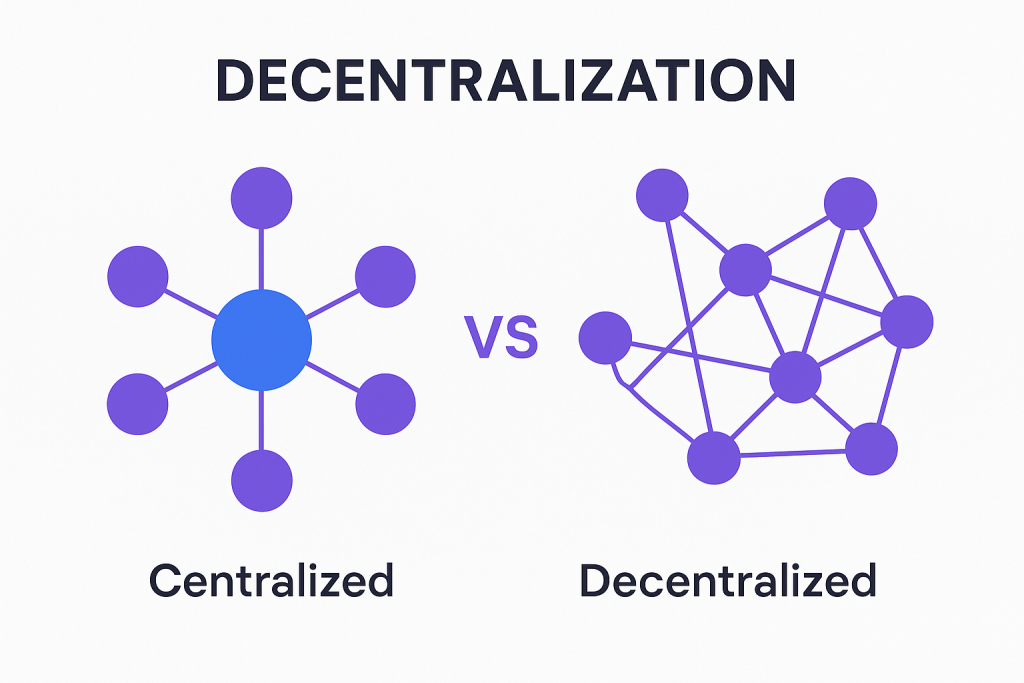
Cryptocurrency is not managed by a single person, company, or government – that’s called decentralization. Instead, control is shared across thousands of computers around the world. When you send money using a bank, the bank controls the system. They can approve, delay, or even block your transaction.
But with cryptocurrency, there is no central boss like a bank. Instead, thousands of people (called “nodes”) around the world help run the system using a technology called blockchain. These nodes check and confirm every transaction to make sure it’s fair and secure.
- No single point of failure – if one server fails, others keep the system running
- More freedom – you are in control of your own funds
- Harder to hack or shut down – because it’s spread out everywhere, not in one place
- No Geographical Limits
One of the great things about cryptocurrency is that it doesn’t have any geographical boundaries so you can transfer money to and from anywhere in the world. You do not have to bother about country borders, banks, or exchange regulations. Suppose you are in the USA and your parents are in India.
If you want to send them money through a bank, the process can be slow, expensive, and paperwork-heavy.
With cryptocurrency, you can send money in the blink of an eye, akin to sending a WhatsApp message.
- Encrypted
Cryptocurrency is extremely safe to trade. Its encryption feature makes sure that your cryptocurrency information, such as wallet and transaction details, is protected with secret codes. This, as a result, makes it impossible for anyone to trace, hack, or modify it.
It’s like placing your message or money in a digital safe that only you can unlock with a private key.
Suppose you are typing a message to your friend, but you don’t want anyone else to see it.
So, you scramble the message using a secret code. Only your friend has the key to unlock and read it.
That’s exactly how encryption works in cryptocurrency. Every transaction is turned into a secure code that only the right people can use.
- Ownership and Control
With cryptocurrency, you are the true owner of your money, no bank, no government, just you.
You store your crypto in a digital wallet, and only you have the private key (like a secret password) that lets you access and control it.
No one else can move, freeze, or block your funds unless you give them permission.
Think of your digital wallet like a locked drawer, and your private key is the only key that opens it.
As long as you keep the key safe, you’re in full control of your money no one else can touch it.
How Does Digital Money Differ From Traditional Currency?
Both traditional money and cryptocurrency are utilized to exchange value, but they fundamentally differ in how they are created, controlled, and used. Let’s understand through a table presented below-
| Feature | Cryptocurrency | Regular Money (Fiat) |
| Who Controls It | Controlled by computers | Controlled by banks/government |
| Where It Exists | On the Internet | In physical and digital form |
| Transfer Speed | Fast, even worldwide | It may take days for international transfers |
| Privacy | Uses codes (addresses) | Linked to your identity |
| Who Can Use It | Anyone with Internet | Needs a bank account often |
What are the benefits of Trading Cryptocurrency?
Trading cryptocurrency means buying and selling digital coins (like Bitcoin, Ethereum, etc.) to make a profit. Here are the benefits of investing in cryptocurrency.
1. High Profit Potential
Crypto prices can go up and down quickly. If someone buys at a low price and sells when it’s high, they can make a good profit. Example: You buy 10 Bitcoins at ₹2 lakhs and sell them at ₹5 lakhs you make ₹3 lakhs in profit.
2. Trade 24/7
Unlike stock markets that close at night or on weekends, crypto markets never sleep. You can trade anytime, day or night.
3. Start with Small Amounts
You don’t need a lot of money to start. You can buy a small part of a coin, even ₹1000 worth of Bitcoin.
4. Global Access
You can trade with anyone in the world, from your phone, without needing a bank account or government ID in some cases.
5. Fast Transactions
Buying or selling crypto is usually quick. You get the coins in minutes and can trade instantly. Crypto trading is exciting and can be profitable, but it’s also risky. Prices can fall fast, too so it’s smart to learn and start small.


Latest News