
What are DAOs?
Forget extensive paperwork, hefty middlemen, and traditional rules — DAOs are rewriting how organizations function. But what exactly are they, and why is everyone in the crypto landscape talking about them?
Contemporarily, companies and organizations are run by a few people at the top — like CEOs and managers — who make the big decisions. But the crypto world brings a new way to manage and grow communities and projects: it’s called a DAO.
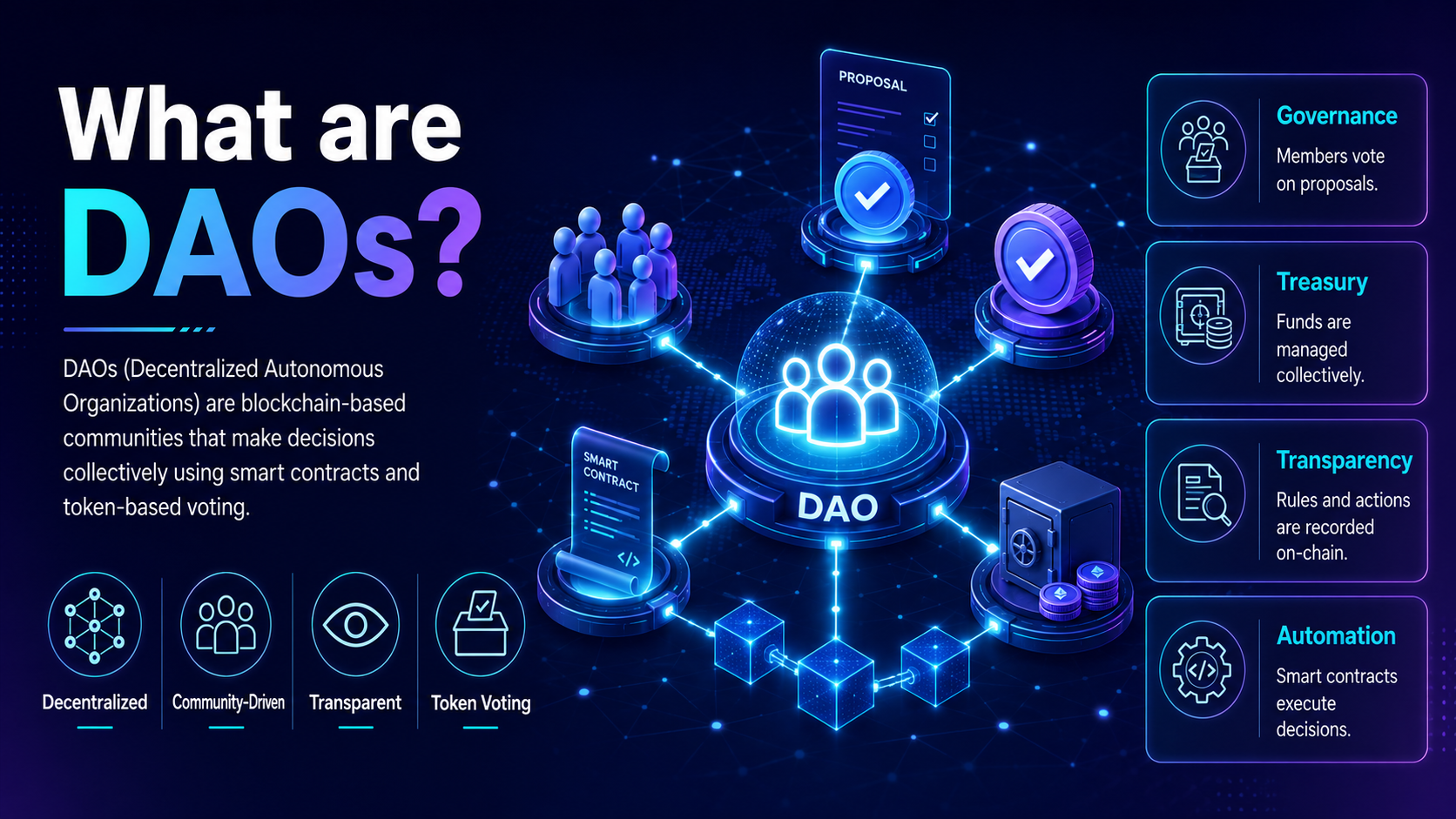
DAO, i.e., Decentralized Autonomous Organization, is like an online group or community that runs without a central boss. All decisions are made by the members, using blockchain technology and smart contracts.
This blog explains how DAO works, along with its key features and benefits.
What are DAOs and Why Does it Matter in the Crypto World?
A Decentralized Autonomous Organization is a new way for people to work together online without needing a boss, a manager, or even a central office. Everything is managed through smart contracts — which are like digital rules written in code on the blockchain.
In simple words, a DAO is an internet-based group or community where decisions are made by members, not by one person or company.
Instead of one person being in charge, everyone who holds a governance token (a special crypto token) can vote on decisions — like how to spend money, make updates, or launch new features. The majority vote determines the outcome, and the smart contract executes accordingly.
Here’s why DAOs are important:
- Trusted system: You do not have to trust a central authority, but the code and the community.
- Global participation: Anyone from anywhere in the world can join and contribute their views.
- Transparency: Everything from rules to votes is written on the blockchain, and everyone can see it.
- Efficiency: Smart contracts automate work without requiring intermediaries.
DAOs are becoming the building blocks of the Web3 future—from managing crypto projects and DeFi apps to funding causes and running online communities.
How Do DAOs Work?
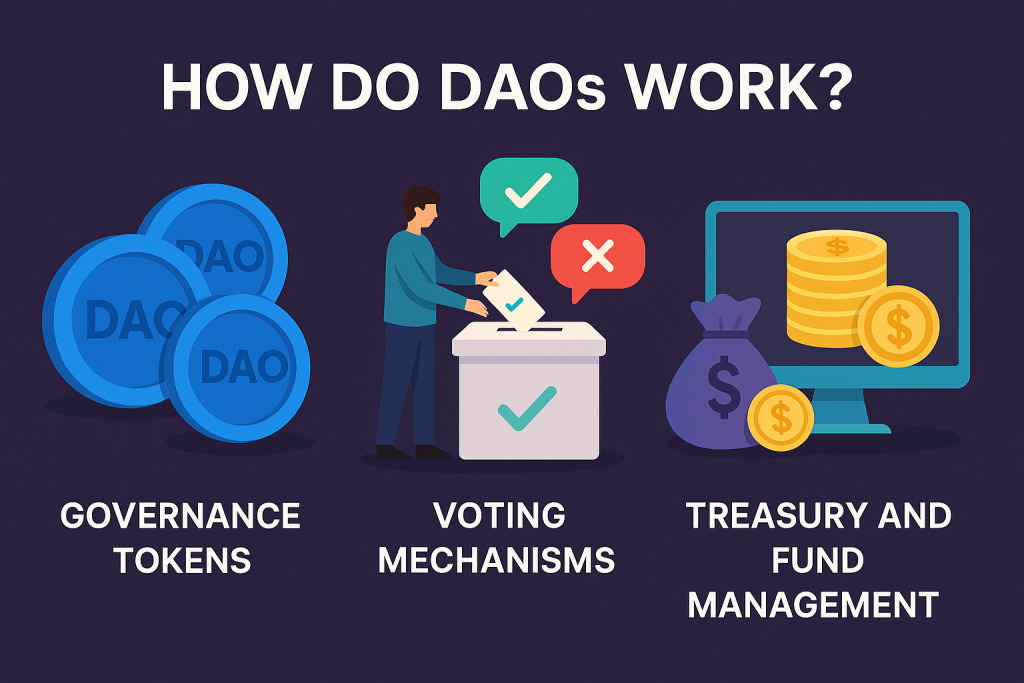
Here’s how it works step-by-step:
Governance Tokens – Your Voice in the DAO
Governance tokens are special crypto tokens that give members the right to vote in a DAO.
- Think of them like voting shares in a company.
- The more tokens you hold, the more voting power you may have (depending on the DAO’s rules).
- You can use them to vote on things like:
- How to spend the DAO’s funds
- Which project to support next
- Changes to the DAO’s rules or structure
Example: If you hold 100 tokens in a DAO and there’s a vote on launching a new feature, your vote counts based on those tokens.
Voting Mechanisms – How Decisions Are Made
Members vote using their governance tokens on a proposal created in a DAO.
- Proposals can be about spending money, updating software, or introducing a new project.
- DAOs use a majority vote system, which means the proposal passes if more than 50% vote is “yes”.
- Voting usually happens on the blockchain, and results are visible to everyone.
Types of voting systems:
- One token = one vote (most common)
- Quadratic voting (reduces the power of whales)
- Delegated voting (you give your vote to someone else you trust)
Treasury and Fund Management – Where the Money Goes
Every DAO has a treasury. It is a digital wallet that holds the group’s crypto funds.
- This treasury is managed by smart contracts—not by a single person.
- Money can only be spent if the community votes to approve it.
- This ensures complete transparency and community control over how funds are utilized.
For example, DAO raises $1 million in crypto. These funds will be deposited in the treasury. Anyone can propose a plan to use some of that money (like building a new app), but it only happens if the majority of members vote to approve it.
| Component | What It Does |
| Governance Tokens | Give members the right to vote on decisions |
| Voting Mechanisms | Allow the community to decide on proposals |
| Treasury | Holds and manages the DAO’s shared crypto funds |
Key Features of DAOs
- Decentralization
In a DAO, there’s no central leader or CEO. Instead, decisions are made by the community using blockchain technology.
- Everyone has a say through voting.
- Power is spread out, not controlled by a small group.
Example:
In Uniswap DAO, token holders vote on changes to the platform instead of one company deciding what’s next. That means users help shape the future of the app.
- Transparency
All the decisions and transactions within a DAO are recorded on the blockchain, which is publicly accessible to members. This builds trust—nothing happens in secret.
- Votes are public.
- Treasury spending is visible.
- Code rules are open-source.
Example:
If a DAO spends 10 ETH on marketing, that transaction can be viewed by anyone on the Ethereum blockchain. No hidden costs or private deals.
- Community-Driven Governance
In DAOs, the token holders propose ideas, vote, and make decisions together. It is like a digital democracy.
- Anyone can suggest changes.
- The majority votes decide what happens next.
Example:
DAO token holders vote on matters such as interest rates and risk settings for the DAI stablecoin. It’s all decided by the users, not a central team.
- Automation through Code
Decentralized Autonomous Organizations are driven by smart contracts. SC ensures that once the prerequisites are met, things happen automatically, without needing anyone.
- No need for human approval.
- No manual processing.
Example:
In a DAO that funds projects, a smart contract might automatically release funds only if a proposal gets 60% yes votes. The system follows the rules—no one can change it last minute.
Popular Examples of DAOs
MakerDAO
MakerDAO is a renowned DAO in the crypto world. It’s best known for creating a stable cryptocurrency called DAI. It is a stablecoin—a type of cryptocurrency that always tries to stay equal to $1 USD.
For Example, Aman owns some Ethereum (ETH) but doesn’t want to sell it. He needs $500 for an urgent expense.
Aman uses MakerDAO to lock his ETH as collateral in a smart contract.
In return, he gets $500 worth of DAI, which he can use just like regular dollars.
Later, when he’s ready, Aman pays back the $500 DAI and gets his ETH back.
Uniswap DAO
Uniswap DAO is the community that governs Uniswap – a platform for swapping (trading) cryptocurrencies without using a central exchange like Binance or Coinbase.
Uniswap runs on the Ethereum blockchain and is fully decentralized. This means it is controlled by the people who use it, not by a company or team.
People who hold UNI tokens are members of the DAO. These members can:
- Propose ideas (like upgrades or changes to the platform)
- Vote on decisions (like how to use the community treasury)
- Help guide the future of the Uniswap protocol
Aave DAO
Aave DAO is the decentralized community that controls Aave, one of the most powerful decentralized lending platforms in the crypto landscape.
It allows individuals to borrow and lend digital coins without going through a bank. The whole system operates on smart contracts (programming on the blockchain), and the rules are determined by the Aave DAO, not a company.
People who hold the AAVE token are part of the DAO. They can:
- Vote on how the protocol works
- Decide which new tokens to add for lending/borrowing
- Manage risk settings and treasury funds
Benefits of DAOs
Global Participation
DAOs are open to anyone in the world with an internet connection and a crypto wallet. There is no bar for location, age, or even formal qualifications.
- You do not need to work in an office or reside in a particular country.
- Everyone can suggest ideas and can vote and contribute.
Example:
A developer from India, a designer from the USA, and a marketer from Australia can all collaborate to work in a DAO without ever meeting in person. That’s global collaboration in action.
Trustless Coordination
In traditional organizations, you usually need to trust the people in charge. But in a DAO, you only need to trust the code and the process, not the people.
- Smart contracts make sure the rules are followed.
- Votes are recorded on the blockchain.
- No one can secretly change decisions.
Example:
If a DAO promises to pay contributors once a task is completed and approved by a vote, the smart contract will automatically release the payment. No need to chase down a manager or HR.
Reduced Operational Costs
DAOs eliminate the middlemen — there is no need for managers, HR teams, or large offices. Smart contracts automate tasks such as payments, voting, and much more.
- It helps you save money on salaries, infrastructure, and admin.
- These funds are used more efficiently for other activities
Example:
A traditional startup might need lawyers, payroll teams, and accountants. A DAO can handle these roles with smart contracts. These, in turn, reduce overhead and use those savings to fund development or rewards for members.
Overall, Decentralized Autonomous Organizations are proving that associations don’t need bosses — they need communities, code, and just a shared vision.
**************************************************
Frequently Asked Questions
What are DAOs and how do they work?
Decentralized Autonomous Organizations are blockchain-based groups run by code and governed by community members using tokens. They work through smart contracts, where members vote on decisions, and actions are executed automatically without a central authority.
Who controls a DAO?
A DAO is controlled by its community of token holders, not a single person or central authority. Decisions are made through voting, where each member’s influence depends on the number of governance tokens they hold.
How to generate DAO?
To create a DAO, you need to write smart contracts that define its rules and governance logic. Then, deploy it using DAO platforms like Aragon, DAOstack, or Snapshot, and distribute governance tokens to your community.
Does Ethereum have a DAO?
Yes, Ethereum had the first major DAO simply called The DAO, launched in 2016, which was later hacked and led to Ethereum’s split into Ethereum and Ethereum Classic. Today, Ethereum supports many DAOs built on its blockchain, like MakerDAO, Uniswap DAO, and Aave DAO.


Latest News