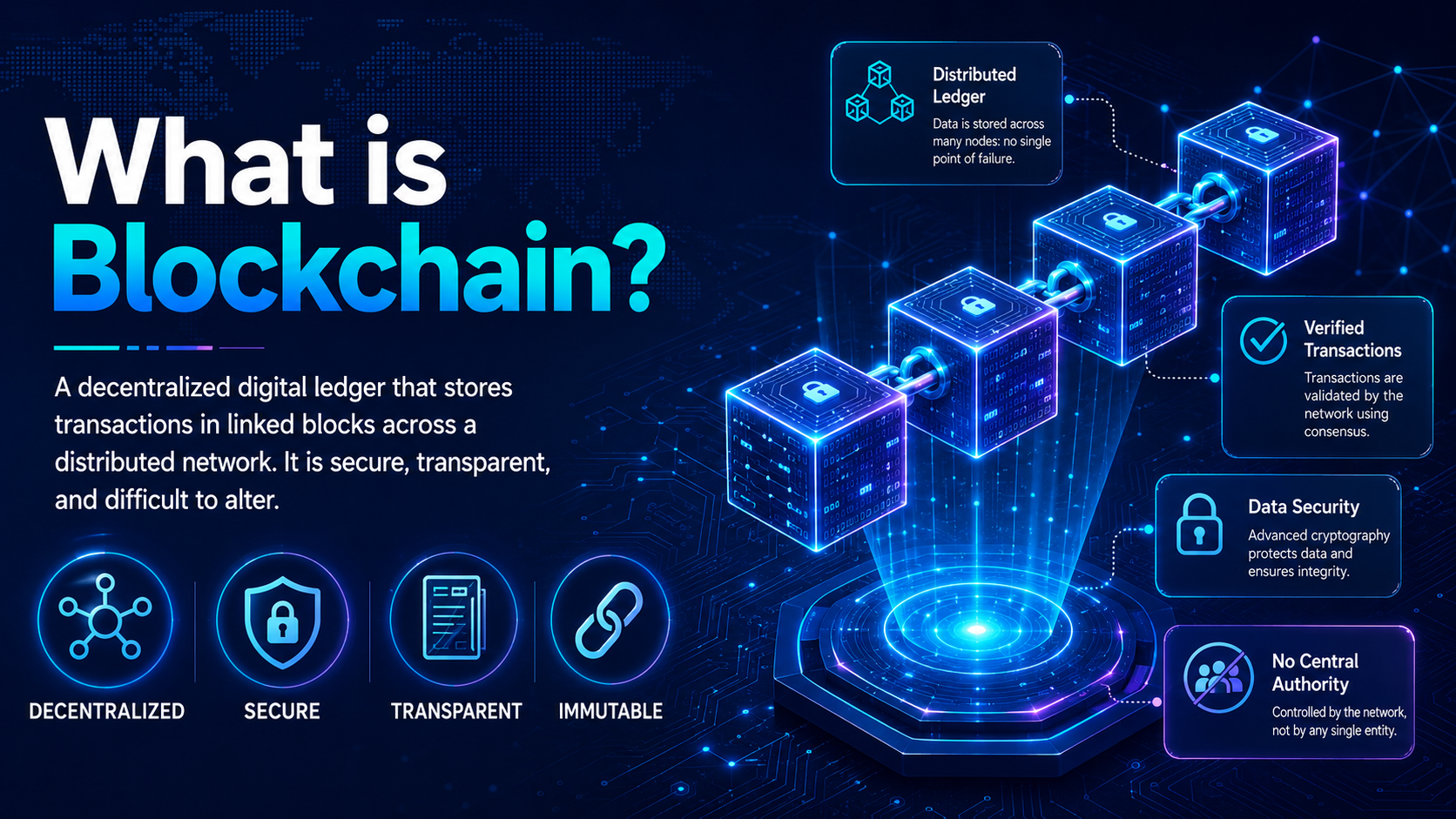

What is Blockchain?
Ever wondered how cryptocurrencies actually work? Well, they are backed by blockchain technology. With this blog, let’s understand more about this technology.
Think of blockchain as a digital notebook – holding a record of every crypto transaction (whether you are buying, selling, or trading). It saves all these records in the right order, so nothing is missed or modified.
The best part is that it doesn’t need a bank or company to manage it — the technology handles everything on its own. That’s why cryptocurrency can work without a middleman.
What is Blockchain?
Blockchain is a digital notebook in which all crypto transactions are noted. Everyone can see and read them, but no one can erase or alter them.
Every time someone sends or receives cryptocurrency, the details are written in this book. These records are:
- Time-stamped (so we know exactly when it occurred)
- Checked by many people (to make sure it’s correct).
These records are stored in blocks. Once a block is full, a new one is created and linked to the last one — like building a chain of blocks. That’s why it’s called blockchain.
This chain is locked tight. If someone tries to change one block, the whole chain will break. So, it’s almost impossible to intrude, cheat, or hack.
Example:
Suppose you are in a classroom, and your teacher writes every student’s payment for a school trip on the board in order.
Once noted down, it can’t be changed, and everyone in the class can see and read it.
If anyone tries to alter any amount, the whole class will know, which makes the record very secure and honest.
A Short History of Blockchain
2008 – The Birth of Blockchain
Blockchain technology was invented by the person who developed Bitcoin. It was created to operate and manage Bitcoin, the first digital cryptocurrency that individuals can trade without needing a bank.
2009 – Bitcoin Launches
The first real use of blockchain happened when Bitcoin went live. It used blockchain as a public record to safely store every transaction.
2015 – Ethereum Brings Smart Contracts
A new blockchain called Ethereum was launched. It bought smart contracts — programs that run on their own when conditions are met. This made blockchain useful for more than just money.
Now – Used Beyond Crypto
Today, blockchain is used in many fields:
- Healthcare (to safely store patient records)
- Supply Chains (to track goods from factory to store)
- Voting systems, identity verification, and more.
Why Blockchain is Powerful
- Everyone can see the same information — it is completely transparent.
- There is no middleman or boss (like a bank or company) needed.
- And it is not just for crypto — blockchain is now being used in multiple domains.
Key Features of Blockchain Technology
This technology boasts multiple key features, including immutable records, decentralization, and others, to enhance security and transparency.
- Decentralization
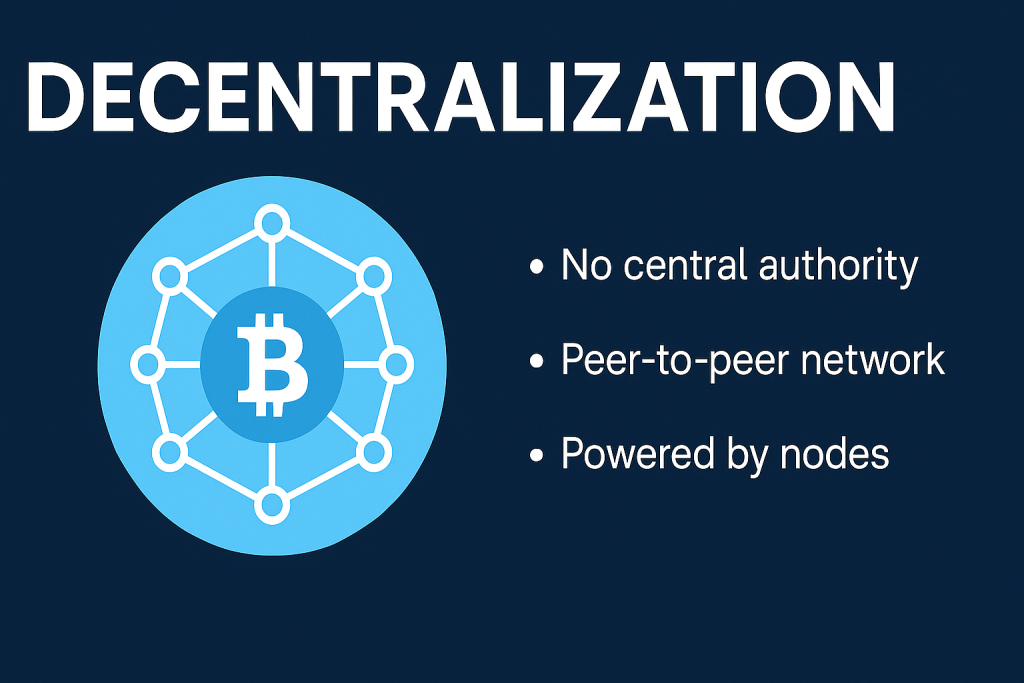
Decentralization means no organization or government controls or manages the blockchain.
In conventional systems, the data is recorded and stored on the central servers. If the system shorts, the entire dataset can be lost and may be difficult to recover.
However, in decentralization, these transactions are copied and kept across lots of computers around the world (called nodes).
Why Decentralization is Useful:
No Single Point of Failure: If one computer (node) goes offline, the blockchain continues to function properly.
Hard to Hack: To cheat the system, a hacker would need to attack thousands of computers at once — nearly impossible!
More Trust: No need to trust a company or authority. You can trust the technology.
- Immutability
Immutability simply means that data, once noted, cannot be changed or deleted. It is permanent, like writing with a pen instead of a pencil.
In a bank or private database, someone with access can edit or delete records. However, in blockchain, when a transaction is added, it is sealed into a block, and that block becomes part of a chain.
If anyone tries to change that block, it would break the connection with all subsequent blocks – disrupting the chain.
Example:
You transfer 10 Bitcoins to a friend.
Once the transaction is approved and added to the blockchain, it becomes a permanent part of the public ledger/blockchain.
Even if you change your mind later, there is no deleting or reversing the transaction. It stays on the blockchain forever.
If a mistake is made (e.g., sending to the wrong wallet), the only solution is to create a new transaction — but the original one will still remain visible.
- Hash Encryptions
Hash encryption in blockchain is a way to protect data in blockchain using special mathematical codes. It turns information into a unique, fixed-length code called a hash — like a digital fingerprint.
Once a transaction is hashed, you can’t reverse it to see the original data — and even a small change creates a completely different hash.
How It Works:
You take some information (like “Kangna sent 1 BTC to Raj”).
The system runs it through a formula (called SHA-256, a hash function).
It converts it into a string like:
5f4dcc3b5aa765d61d8327deb882cf99
(Note: Real hashes are longer and more complex.)
If anyone tries to change even a single letter, a new and totally different hash is created — making it clear the data was tampered with.
Every block in the blockchain has:
- Its own hash
- The hash of the prior block
- Transparency
Transparency means everyone on the network can see and read the transaction history. Nothing is hidden — the system is open and visible to all currency holders.
But don’t worry — Even though transactions are public, no names or personal details are revealed – only wallet addresses are shown. You stay pseudonymous (you have an ID like 0x98F…, but not your real name).
- Builds trust: Everyone can verify transactions themselves.
- Easy to audit: Anyone can check past records, balances, or smart contract activity.
- No hidden changes: Everything is recorded and visible forever.
- Distributed Ledger (DL)
DL is like a shared digital record that is saved on multiple computers (nodes) across the planet, and not on a single central server.
Every node on the network has a copy of the entire transaction history. And whenever a new transaction occurs, all copies are updated simultaneously.
Example:
Suppose you are going on a vacation with friends and want to keep track of your expenses.
Instead of one person noting ‘who paid what’, everyone maintains their own notebook.
Whenever someone pays for something, all friends write it down together.
If, in case, anyone’s notebook is lost, the rest still have the expense details with them.
That’s how a distributed ledger operates — safe, shared, and always up-to-date.
How It Works in Blockchain:
Each computer (called a node) stores a full copy of the blockchain.
- When a transaction is made, it is sent to all nodes.
- All nodes verify it and update their ledger/book.
This ensures that there is no single point of failure and helps keep the system honest and always running.
- Consensus Mechanism
This mechanism is a way for all computers on a blockchain to agree on what is true. All nodes work together to determine which transactions are genuine and authentic.
Consensus is Important Because:
- It ensures only valid transactions are added
- It prevents fraud, double spending, and fake data
- It keeps all copies of the blockchain in sync and trustworthy
Popular Types of Consensus Mechanisms:
| Mechanism | Who Validates? | Used By | Key Idea |
| Proof of Work | Fastest puzzle solvers | Bitcoin | Solve puzzles to earn the right to add data |
| Proof of Stake | Coin holders | Ethereum (now) | More stake = more chance to validate |
| Proof of Authority | Trusted selected validators | Private blockchains | Verified identities = faster approval |
Different Types of Blockchain Networks in Crypto
There are multiple types of blockchain networks, each created for specific use cases. Let’s discuss these networks briefly.
- Public Blockchain
Anyone can join, view, and take part in the network. No one owns or controls it. Think of it like Wikipedia — anyone can read it, and many people can help update it.
- Private Blockchain
Only selected individuals or companies can join or see the data. It’s usually used for internal business purposes. Think of it like a company’s internal documents — only employees can access them.
- Hybrid Blockchain
This blockchain network combines the features of both public and private. Some data is public, while confidential data is kept private. For example, an airport — public areas (like lobbies) and private areas (like control rooms).
- Consortium Blockchain
More than one organization manages it together. So, it’s not open to all, but it’s not fully private either. You can think of it as a shared Google Sheet between a few trusted companies.
Frequently Asked Questions
Q.1 What is a blockchain in beginner-friendly terms?
Blockchain is a public ledger that records and stores transactions. These records are permanent; no one can erase or modify any data.
Q.2 What are the four types of blockchain?
The four types of blockchain networks include: Public Blockchain, Private Blockchain, Hybrid Blockchain, and Consortium Blockchain.
Q.3 What is the blockchain used for?
Blockchain technology has several applications beyond cryptocurrency, including supply chain management, digital identity, financial services, data management, and more.
Q.4 Can a blockchain be hacked?
It is very difficult to hack the blockchain. The level of security depends on several factors, such as consensus mechanisms, encryption techniques, and computing power.


Latest News