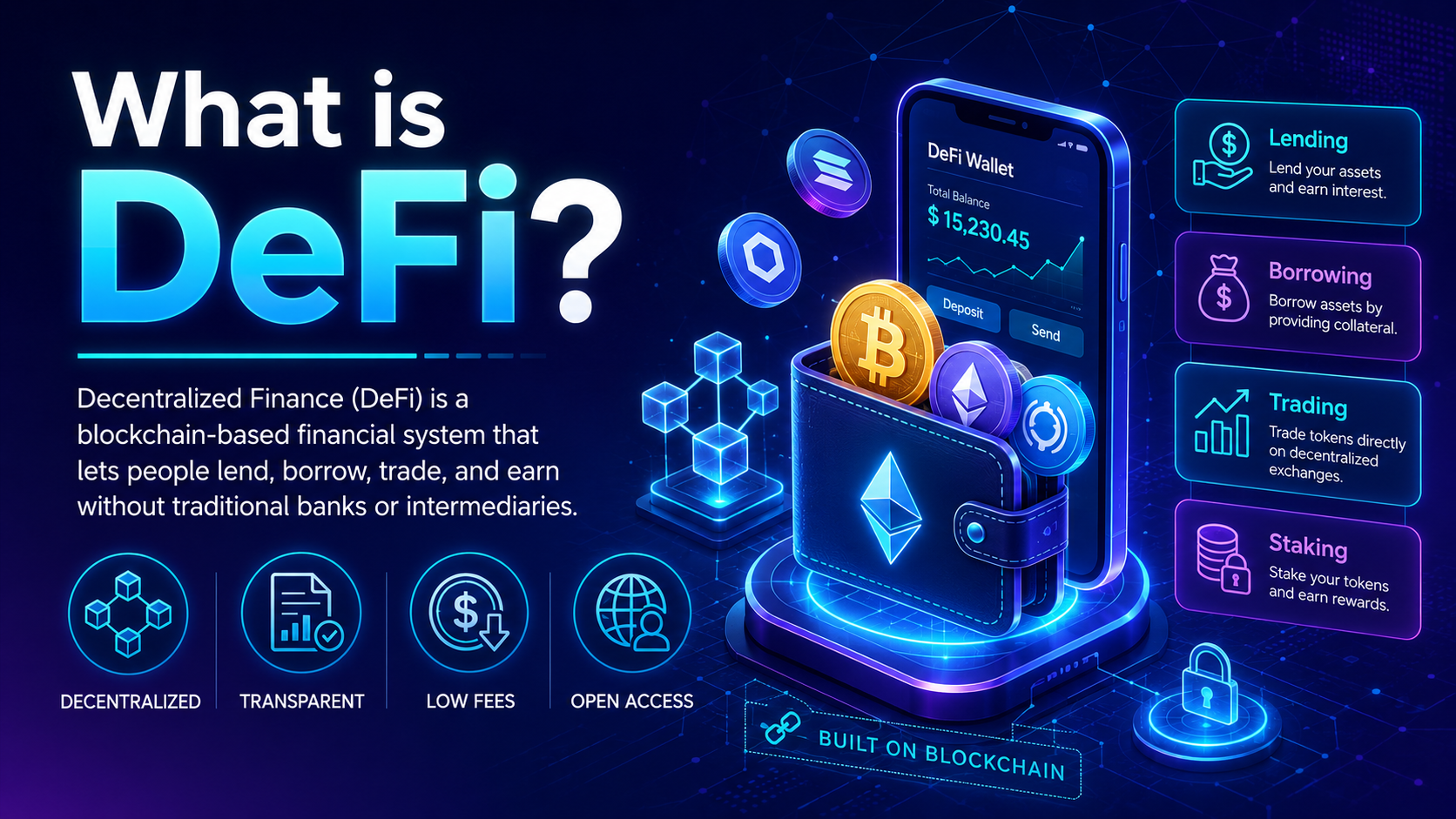

What is DeFi?
If you have heard of crypto but do not know DeFi — you are only getting half the story.
In recent years, a new wave of financial innovation has swept the cryptocurrency world — and it’s called DeFi, short for Decentralized Finance. But what exactly is DeFi, and why is everyone talking about it?
Decentralized Finance is the fastest growing ecosystem of financial tools and services built on blockchain technology. It eliminates the need for banks, brokers, and traditional financial institutions.
Let’s break down everything you need to know about DeFi.
DeFi: What Is It?
Decentralized Finance is a new approach to managing money that doesn’t rely on banks or intermediaries.
This system enables you to send money, take a loan, or earn interest directly using apps built on blockchain, like Ethereum.
With DeFi:
- You stay in control of your money
- You don’t need to ask permission to use financial services
- Everything runs on code instead of human approval
It’s like turning your crypto wallet into your own personal bank — available 24/7, from anywhere in the world.
For example, in traditional finance, you deposit money in a bank, and the bank lends it to others. You earn a small interest.
In DeFi, you use a platform like Aave or Compound to lend your crypto directly and earn interest instantly, with no bank in the middle.
Key Principles Behind DeFi
1. Decentralization
There’s no central authority like a bank or company controlling the system. Instead, DeFi runs on blockchains (like Ethereum), where decisions are made by code and the community.
Think of it like replacing the bank manager with a smart contract — a program that runs automatically.
2. Permissionless Access
Anyone with an internet connection and a crypto wallet can use DeFi — no need to apply, sign up, or ask permission.
Whether you’re in India or Brazil, you have the same access as anyone else — instantly.
3. Transparency
All DeFi transactions are stored on a public blockchain. Anyone can see how the system works and track the movement of money.
It is like having a bank where the books are open 24/7 for everyone to see the details.
4. Self-Custody (You Control Your Money)
With DeFi, you hold your own funds in a personal crypto wallet — not a bank or third party. You’re fully in control.
No more freezing accounts or withdrawal limits — your wallet is your bank.
5. Smart Contracts
DeFi apps are powered by smart contracts — pieces of code that automatically execute rules like lending, borrowing, or trading.
No need for paperwork — smart contracts do the job instantly and fairly.
6. Interoperability (Money Legos)
Most DeFi apps can connect and work together like building blocks — users can mix features from different platforms.
For example, you can borrow from one app, trade on another, and earn rewards from a third — all in one flow.
How DeFi Works
- Blockchain & Smart Contracts: What are they?
What is a Blockchain?
A blockchain is like a digital notebook that records every transaction — but instead of one person owning the notebook, everyone has a copy.
It’s public, secure, and can’t be changed once written.
Every time you send or receive crypto, it’s written on the blockchain — just like a new line in the notebook.
Think of it like Google Docs for money — everyone can see the updates, and no one can secretly change the past.
What is a Smart Contract?
A smart contract is a computer program that runs automatically on the blockchain.
It follows rules written in code.
When certain conditions are met, it automatically does the job — no middleman needed.
Example: A smart contract can say — “If Alice deposits 1 ETH, send her back 1.5 ETH after 30 days.” Once written, it will do that on its own, no one can stop or change it.
How does this power DeFi?
In DeFi, blockchains store the records, and smart contracts handle the actions like:
- Lending and borrowing
- Swapping tokens
- Paying interest
- Locking funds for rewards
Everything is automatic, transparent, and controlled by code instead of people.
- Role of Ethereum in DeFi
Why Ethereum?
Ethereum is like the home base of DeFi. It was the first blockchain to support smart contracts, which are the building blocks of DeFi apps.
Just like your phone needs an operating system (like Android or iOS) to run apps…
DeFi apps need a blockchain like Ethereum to run.
That’s why most DeFi platforms — like Uniswap, Aave, and MakerDAO — were first built on Ethereum.
What Does Ethereum Do in DeFi?
- Stores transaction history (who sent what to whom)
- Runs smart contracts that handle lending, trading, staking, etc.
- Keeps everything secure and decentralized
- It’s like a giant computer network where no one can cheat or shut it down.
Core Components of DeFi
- Decentralized Exchanges
Decentralized Exchange (DEX), a crypto trading platform, allows you to buy, sell, or trade tokens, without any middleman.
These Exchanges let you trade directly from your own wallet, unlike regular crypto exchanges (like Binance or Coinbase), where your funds are held by the company.
How DEXs Work:
No sign-up or ID needed — just connect your crypto wallet (like MetaMask).
Trades are done using smart contracts — so no human controls your funds.
Your tokens never leave your wallet until the trade is completed.
Example:
Imagine you want to swap Ethereum (ETH) for USD Coin (USDC).
On a DEX like Uniswap or PancakeSwap, you:
- Connect your wallet.
- Choose the token you have and the one you want.
- Click “Swap” — and the smart contract handles the rest.
- Lending and Borrowing Platforms
In traditional finance, banks lend money and charge interest. But in DeFi, you can lend or borrow crypto directly using smart contracts — no banks needed.
These platforms connect lenders (who want to earn interest) with borrowers (who need crypto) in a safe, automatic, and decentralized way.
How Lending Works in DeFi:
- You deposit your crypto (like USDC or DAI) into a DeFi platform like Aave or Compound.
- Your crypto gets added to a big pool.
- Other users can borrow from that pool.
- You earn interest as long as your funds stay deposited.
- It is like putting your money in a digital piggy bank that pays you automatically.
Why It’s Safe (Most of the Time):
- Smart contracts control everything — no humans can touch your money.
- Everything is transparent and happens instantly.
- However, you must be cautious of risks such as price crashes or smart contract bugs.
- Stablecoins
These cryptocurrencies are designed to stay at a stable price, usually pegged to a real-world currency like the US Dollar.
In Decentralized Finance, stablecoins play a vital role. They make it easier for people to:
- Avoid huge price swings
- Trade, lend, borrow, or earn interest with more stability
- Use DeFi apps without worrying about market crashes
Why Are Stablecoins Important in DeFi?
Most cryptocurrencies go up and down in price quickly — which can be risky.
However, with stablecoins, you gain the benefits of crypto, such as speed, decentralization, and no banks, while maintaining the complete stability.
How Are Stablecoins Utilized in DeFi?
- Trading: You can exchange stablecoins for other tokens without leaving DeFi.
- Lending & Borrowing: You can earn interest or get loans in stablecoins like USDC.
- Staking & Yield Farming: You can stake stablecoins to gain rewards with lower risk.
- Yield Farming & Liquidity Pools
Yield farming and liquidity pools are two powerful ways to earn passive income with your crypto in DeFi.
Think of it like “putting your money to work” — but instead of using a bank, you’re using DeFi apps and smart contracts.
What Are Liquidity Pools?
A liquidity pool is a collection of crypto tokens locked in a smart contract.
These tokens are used by Decentralized Exchanges (DEXs) to allow people to trade.
For example:
- You deposit ETH and USDC into a pool on Uniswap.
- Others use this pool to swap between ETH and USDC.
- In return, you earn a small fee every time someone makes a trade.
- It’s like providing cash to a currency exchange booth, and you earn a cut from every transaction.
What is Yield Farming?
Yield farming means moving your crypto between different DeFi platforms to maximize the rewards you can earn — usually in the form of interest, tokens, or fees.
It often involves:
- Providing liquidity to pools
- Staking tokens in farms or vaults
- Earning rewards in return, often paid in native tokens (like UNI, CAKE, or COMP)
Think of it like a digital treasure hunt — the more strategic you are, the more rewards you can collect.
Example:
- You deposit USDC and DAI into a Curve Finance pool.
- You earn fees from people swapping those tokens.
- On top of that, Curve rewards you with CRV tokens — this is yield farming in action.
- Synthetic Assets
Synthetic assets are digital tokens that represent real-world assets — like stocks, gold, or fiat currencies — but are created and traded on the blockchain.
They “mimic” the value of real things, allowing you to gain price exposure without actually owning the asset.
Think of it like a mirror: the synthetic token reflects the price of the real asset — but it’s digital and decentralized.
Let’s say you want to invest in Apple stock (AAPL), but you only use crypto.
- On a DeFi platform like Synthetix, you can buy a token called sAAPL, which copies the price of real Apple stock.
- If Apple stock goes up 5%, your sAAPL also goes up 5%.
- You don’t own real shares, but you can trade and profit just like you would in the traditional market.
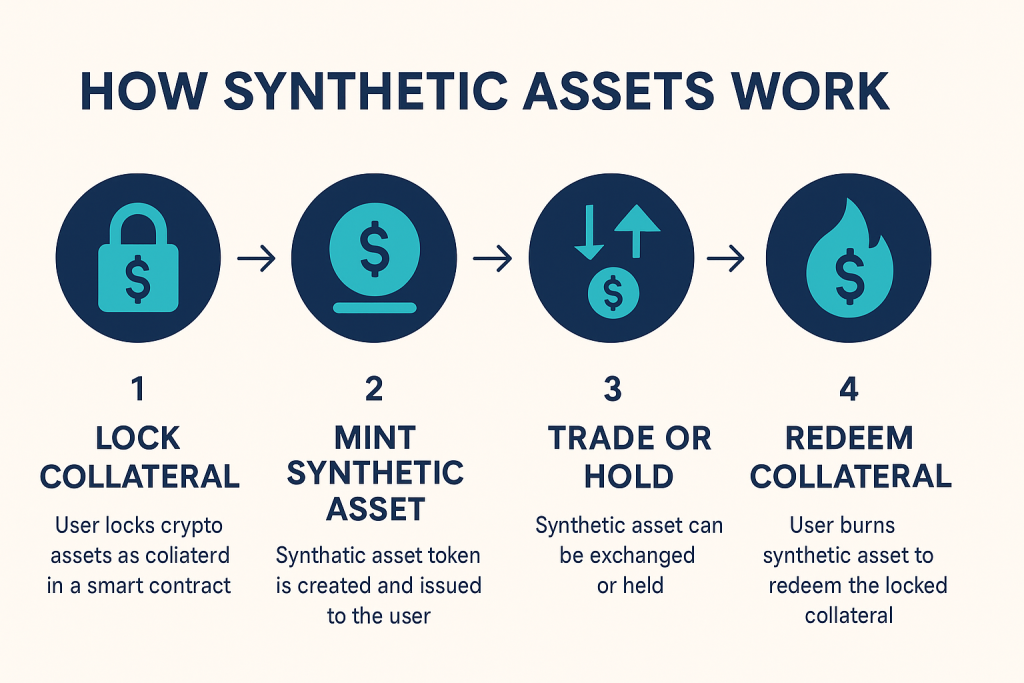
How Synthetic Assets Work:
- Synthetic assets are created using smart contracts and backed by collateral (like crypto tokens).
- Users lock up crypto in a smart contract.
- In return, they obtain synthetic tokens, “synths,” that track the value of real-world assets.
- These tokens can then be traded and held in other DeFi apps.
Benefits of DeFi
Here are the benefits of using DeFi:
Borderless & Permissionless Access
Anyone, anywhere in the world can use DeFi — no bank account, ID, or approval needed.
Example:
Priya in India and Alex in Brazil can both use the same DeFi app to earn interest, swap tokens, or get a loan — all they need is a smartphone and a crypto wallet.
There are no gatekeepers. DeFi is open 24/7 to everyone.
2. Full User Control of Funds
You always keep control of your money. It stays in your wallet, not locked in a bank or exchange.
Example:
Rahul deposits USDC into a DeFi lending platform from his wallet. He can withdraw it anytime — no need to wait for a bank or support team to approve it.
You’re your own bank. You decide when and how to move your funds.
3. Faster & Cheaper Transactions
Decentralized Finance apps operate automatically using smart contracts, and hence, eliminate delays, paperwork, and extra fees associated with middlemen.
Example:
Emma sends $500 in USDC to a friend in Nigeria using a DeFi app. It arrives in minutes — with very low fees — instead of waiting days like a bank transfer or paying high charges through PayPal.
Quick, low-cost transactions — no bank holidays or hidden charges.
Overall, decentralized Finance helps remove intermediaries and enable peer-to-peer transactions on blockchain networks. It empowers users with greater control, transparency, and global access to financial tools.
*******************************************************************
Frequently Asked Questions
What is a DeFi in crypto?
Decentralized Finance in crypto refers to financial services built on blockchain technology that operate without traditional intermediaries. It enables peer-to-peer transactions through smart contracts, offering greater transparency and control to users.
How to make money with DeFi?
You can make money with DeFi by earning interest through lending your crypto, staking tokens, or providing liquidity to decentralized exchanges.
Is DeFi crypto safe?
DeFi offers transparency and control, but it is not entirely risk-free due to smart contract bugs, platform vulnerabilities, and market volatility.
Does bitcoin use DeFi?
Bitcoin itself is not part of the DeFi ecosystem, as it was designed primarily as a digital currency and store of value. However, wrapped versions of Bitcoin (like wBTC) are used on DeFi platforms built on other blockchains, such as Ethereum, to enable DeFi functionality.


Latest News